

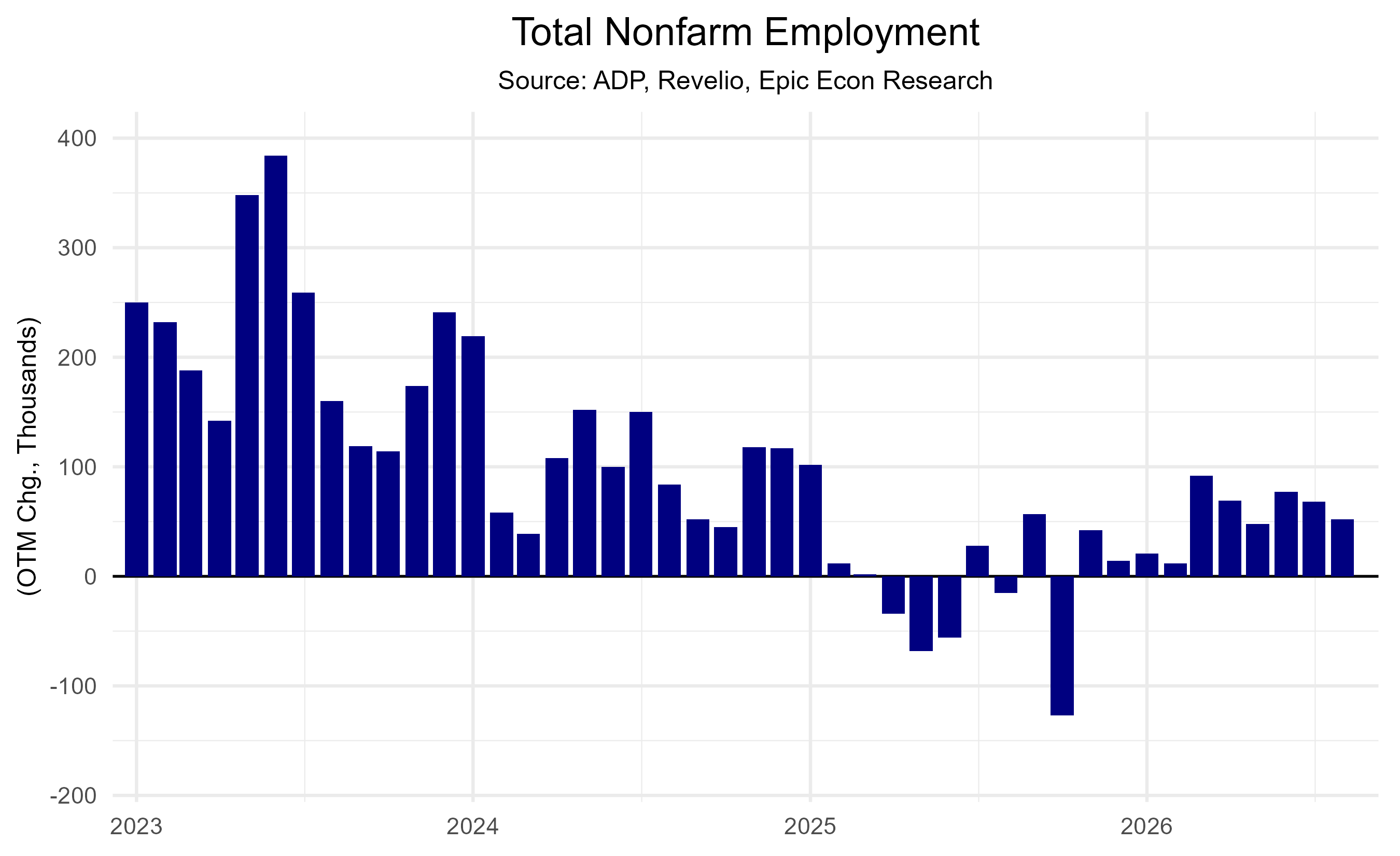
Total nonfarm payroll employment increased by 52,000 in August, while the number of currently active job postings declined by 101,000, or 1.4 percent, to 6.9 million, Epic Econ estimates show.
Job gains occurred in education and health services (+24,000), construction (+11,000), and financial activities (+8,000). Employment declined in trade, transportation, and utilities (-9,000) and manufacturing (-6,000), while most other sectors changed little.
Private nonfarm employment increased by just 24,000 in August, while the remaining increase came from government employment (+27,000), a measure that should be interpreted with considerable caution. Revisions to prior months further weakened the employment picture. Cumulative job creation from January 2025 through July 2026 was revised down by 215,000 jobs.
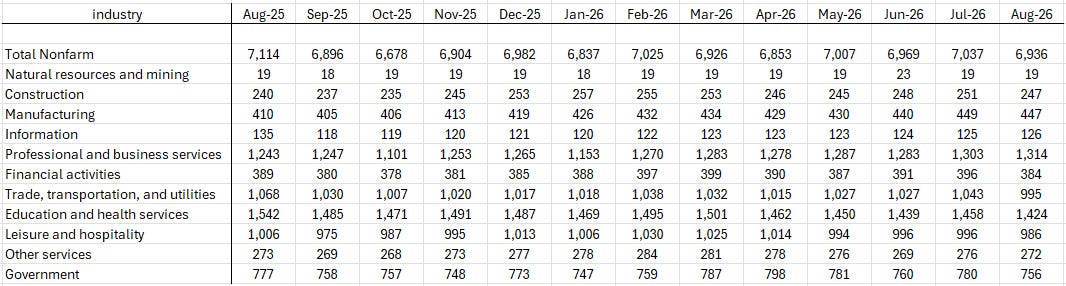
Job postings declined across a wide range of sectors, particularly trade, transportation, and utilities (-48,000), education and health services (-34,000), government (-24,000), and financial activities (-12,000).
Private-sector labor market data, while incredibly useful, is not typically collected using a nationally representative sample like the Current Population Survey (CPS) or Current Employment Statistics (CES) program. Even when private data are weighted or benchmarked to administrative data, estimates can contain significant bias or gaps in coverage. After analyzing a number of private-sector labor market datasets, I continue to believe a “wisdom of the crowds” approach provides the most useful real-time signal.
The results should be viewed as a forecast of and complement to Friday morning’s official Employment Situation.
Nonfarm Payroll Employment
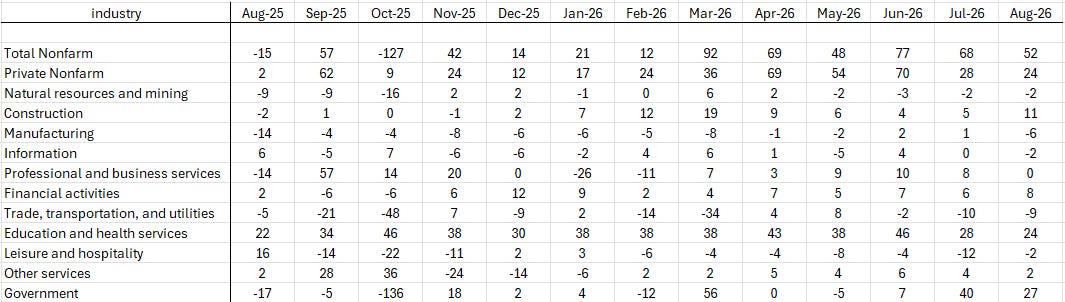
Total nonfarm payroll employment increased by 52,000 in August. Thus far in 2026, the U.S. economy has added an average of roughly 55,000 jobs per month. Over the past twelve months, however, employment has increased by just 425,000, or an average of 35,000 jobs per month.
Crucially, historical data were revised substantially lower. Estimated employment growth from January 2025 through July 2026 was revised down by 215,000 jobs relative to last month’s data. Private-sector employment accounted for 178,000 of the downward revision.
The largest revisions occurred in education and health services (-62,000), leisure and hospitality (-42,000), trade, transportation, and utilities (-40,000), government (-37,000), and manufacturing (-31,000).
This is an important reminder that private-sector employment data — whether it be from online career profiles or payroll records — can be subject to significant revisions, just like its public counterpart. But the overall trend remains the same: job creation is anemic.
Education and Health Services
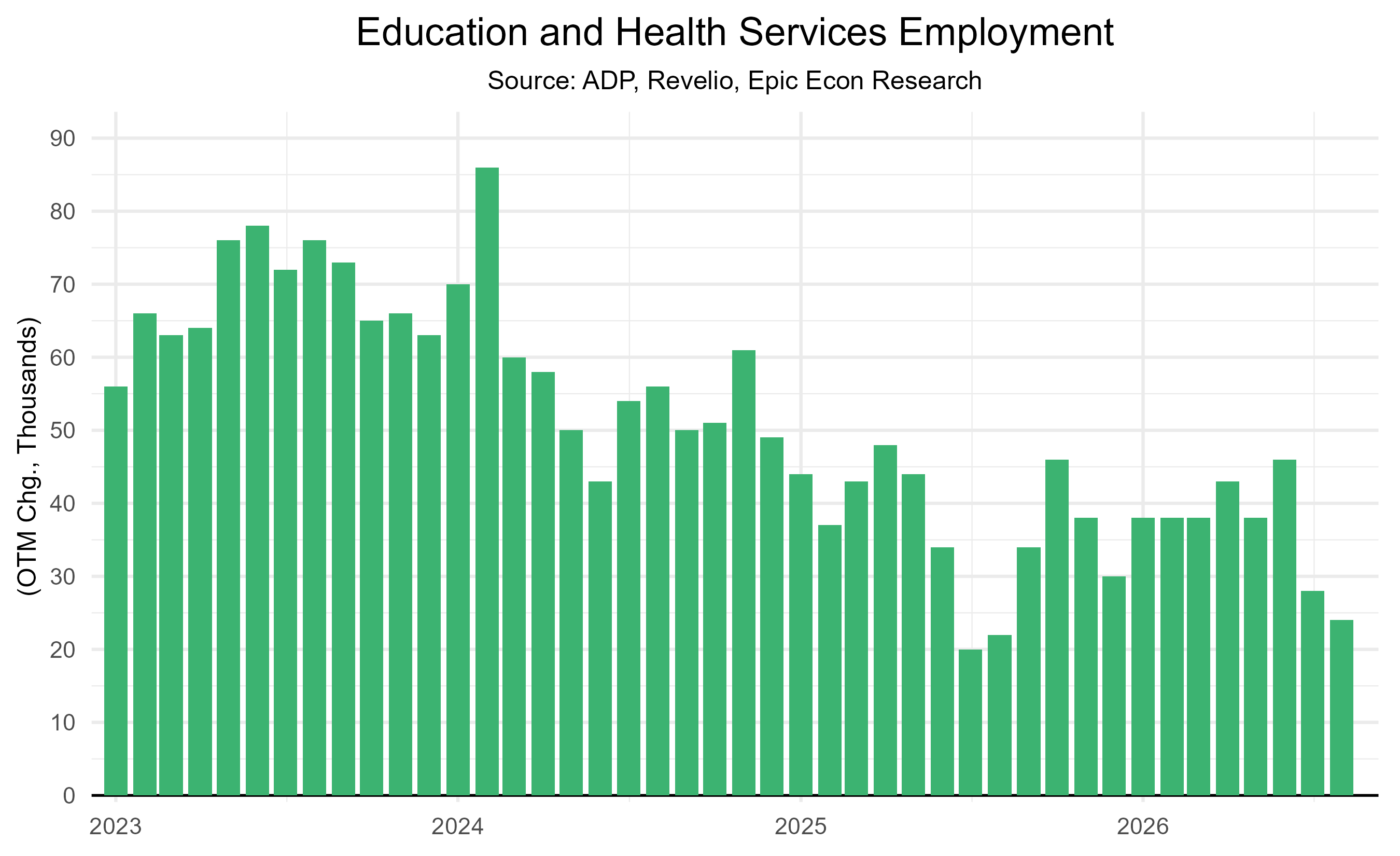
Employment in education and health services increased by 24,000 in August. The sector remains the primary engine of U.S. job creation, adding 293,000 jobs thus far in 2026, and 441,000 over the past twelve months. However, hiring has clearly slowed in the latter stages of the summer.
The job postings data reinforce this message. Education and health services openings declined by another 34,000 in August, and are now 15.7 percent below their January 2025 level.
Construction
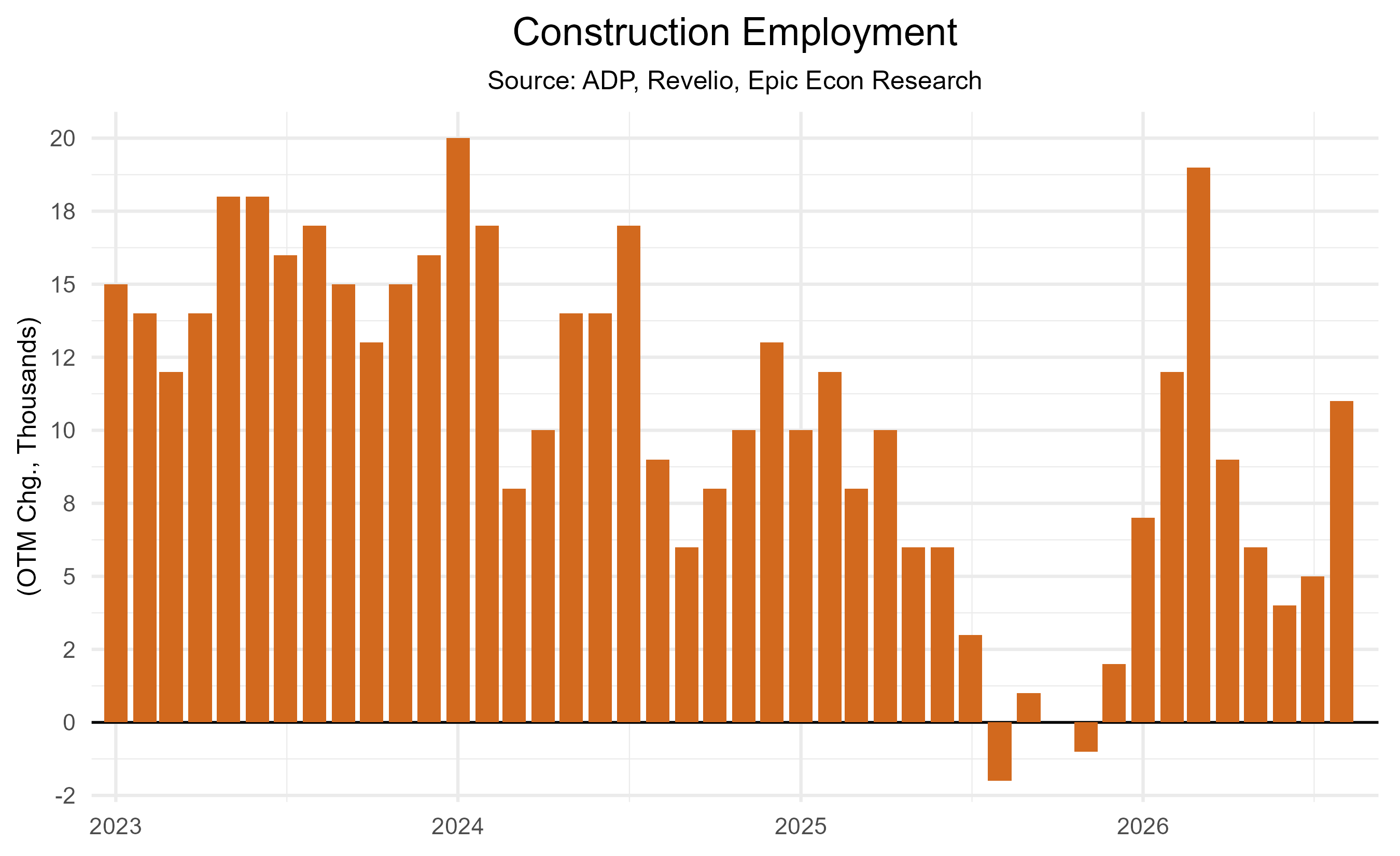
Construction employment increased by 11,000 in August. The sector has added 73,000 jobs thus far in 2026, continuing to outperform much of the rest of the labor market.
Nonresidential construction associated with the buildout of AI infrastructure, including data centers, technology manufacturing facilities, and energy investment continued to lead to job creation, even as residential construction faces headwinds due to high borrowing costs and tariffs.
Job postings declined slightly (-4,000) in August, and are essentially unchanged from January 2025. But with Nvidia’s strong earnings report last week, it is possible the AI-related construction boom has room left to run.
Financial Activities
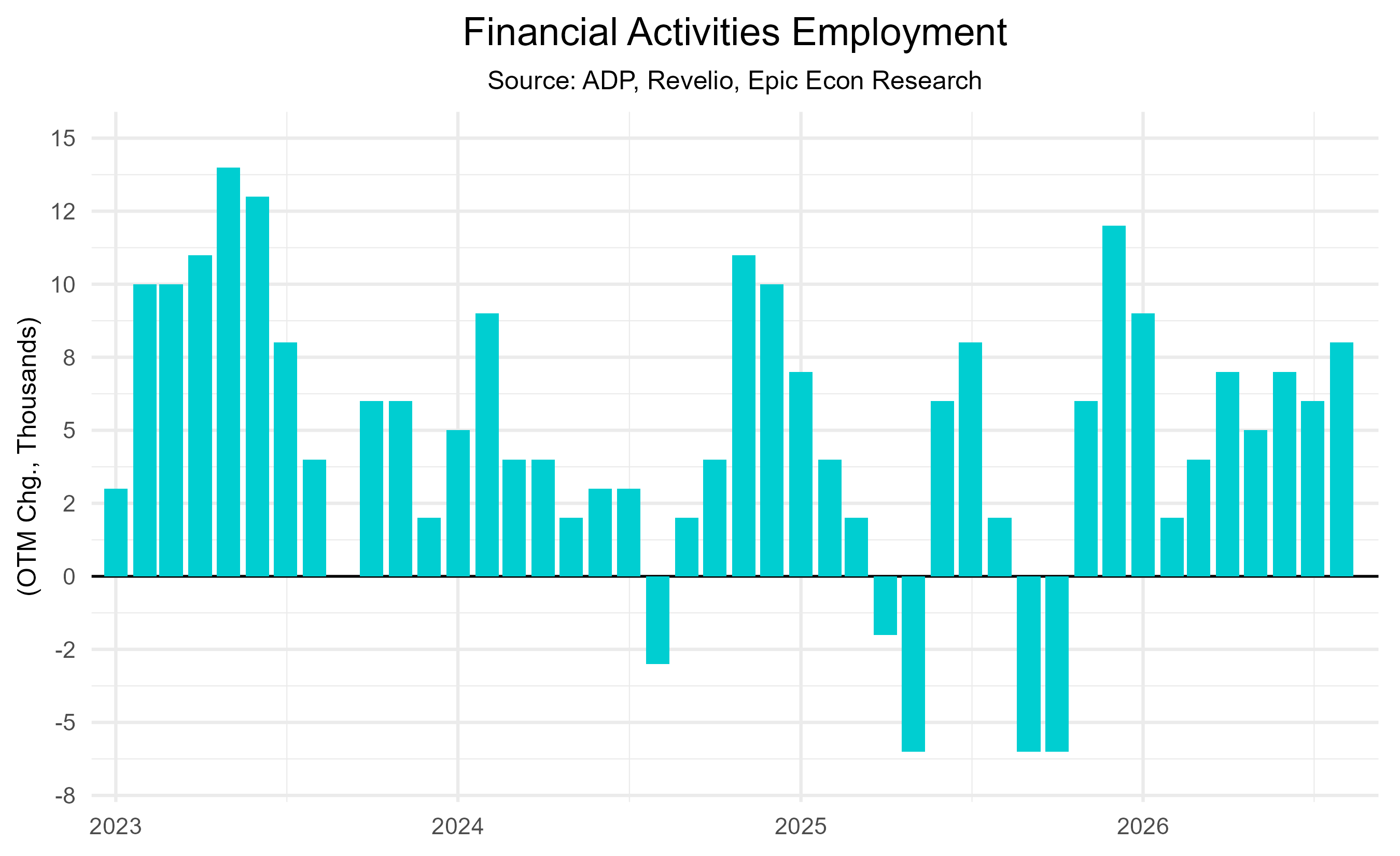
Employment in financial activities increased by 8,000 in August and has risen by 48,000 thus far in 2026. This has been one of the more consistently positive private-sector employment trends this year. Job postings were weaker, declining by 12,000 over the month. The number of available positions is now about 5 percent below January 2025.
Trade, Transportation, and Utilities
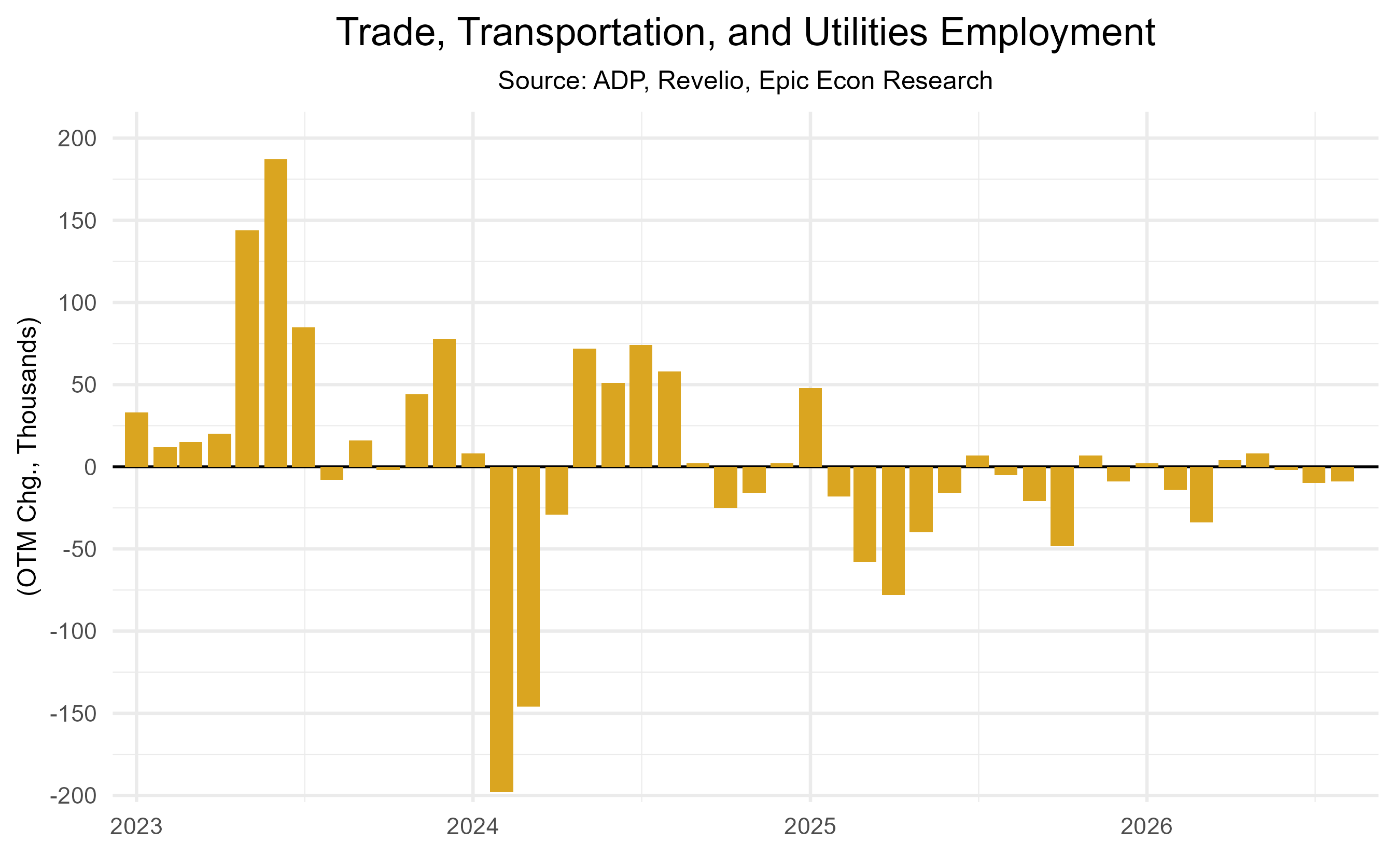
Employment in trade, transportation, and utilities declined by 9,000 in August. The sector has lost 55,000 jobs thus far in 2026 and 126,000 over the past twelve months. Employment has been trending down since early 2025, with total employment now roughly 285,000 below its December 2024 level.
Hiring demand weakened sharply in August as well. Job postings declined by 48,000, the largest decline of any sector, and are now 11.1 percent below January 2025.
This weakness likely reflects a combination of soft goods demand, a correction in freight and logistics, and rising labor productivity across the super sector. In retail and wholesale trade, for instance, output rose in 2025 even as hours worked declined. More recently, inventory stockpiling and volatile import arrivals due to tariffs and the War in Iran may also be weighing on hiring.
Manufacturing
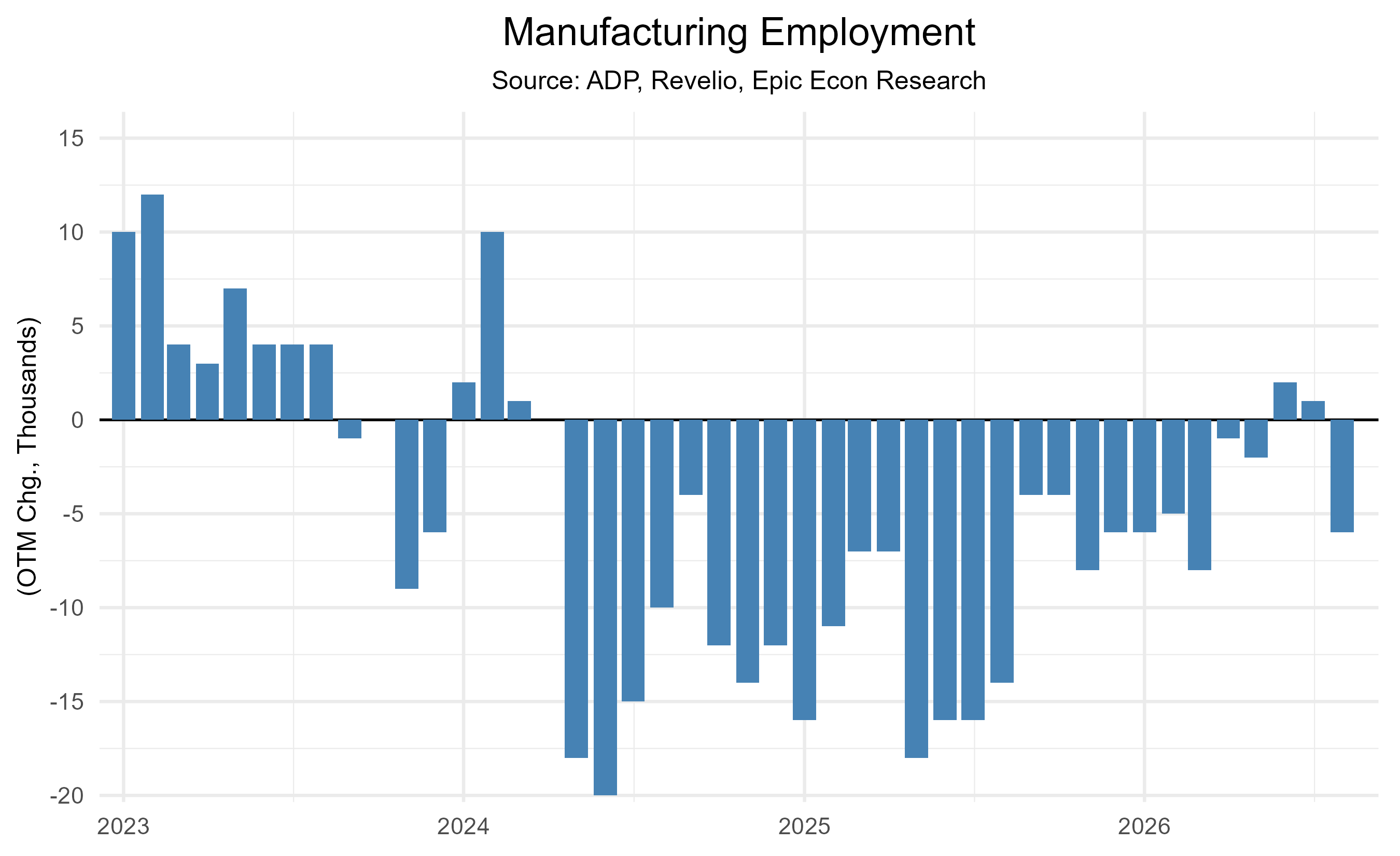
Manufacturing employment declined by 6,000 in August. The sector has lost 25,000 jobs thus far in 2026, 47,000 over the past twelve months, and roughly 152,000 since the end of 2026. But in line with strong orders data last week, job postings remain strong. They edged down by just 2,000 in August, and remain 10.4 percent above their January 2024 level. This story was echoed by JOLTS data earlier this week, showing a significant rise in durable goods job openings.
Professional and Business Services and Information


Employment in professional and business services was unchanged in August after modest gains over the prior several months. Employment in information edged down by 2,000.
Importantly, the job-postings data do not show a broad deterioration in traditionally white-collar industries. Professional and business services postings increased by 11,000 in August, while information postings edged up by 1,000. Professional and business services job postings are only 2.9 percent below January 2025, while information postings are actually 8.6 percent higher.
For now, I see little macroeconomic evidence of a generalized A.I.-driven collapse in white-collar employment. Certain firms and occupations are undoubtedly being disrupted, but aggregate employment and job-postings data continue to look more like stagnation than technological mass unemployment.
Leisure and Hospitality
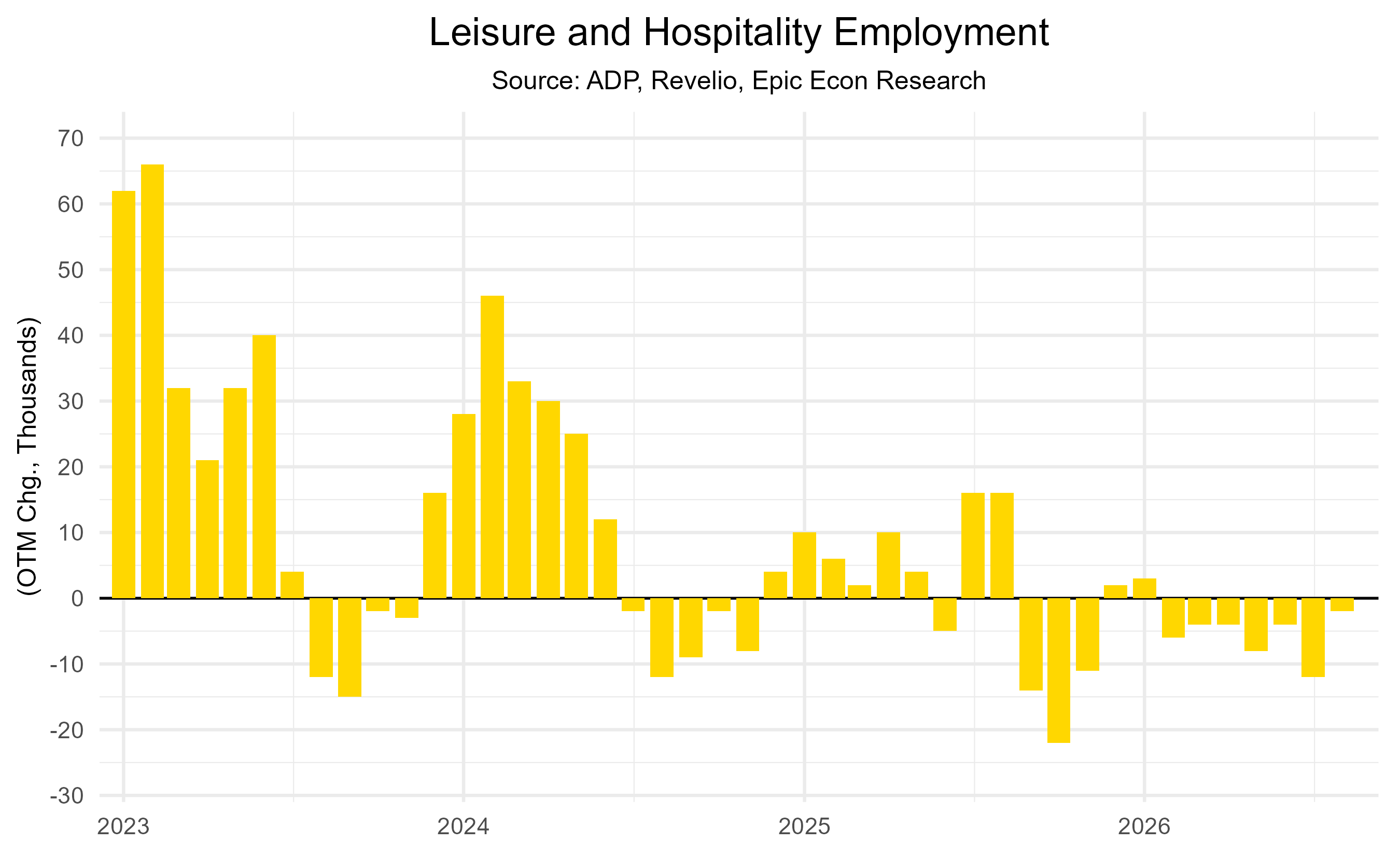
Leisure and hospitality employment edged down by 2,000 in August. The sector has lost 37,000 jobs thus far in 2026 and 82,000 over the past twelve months.
Job postings declined by 10,000, but remain only 2.5 percent below January 2025 — substantially better than most other service sectors.
This combination of relatively stable vacancies and weak employment is consistent with a high-turnover industry in which businesses continue to recruit but are reluctant to expand overall staffing. There is also no evidence of a meaningful, macro-level employment boost from the U.S. hosting the FIFA World Cup earlier this summer.
Government
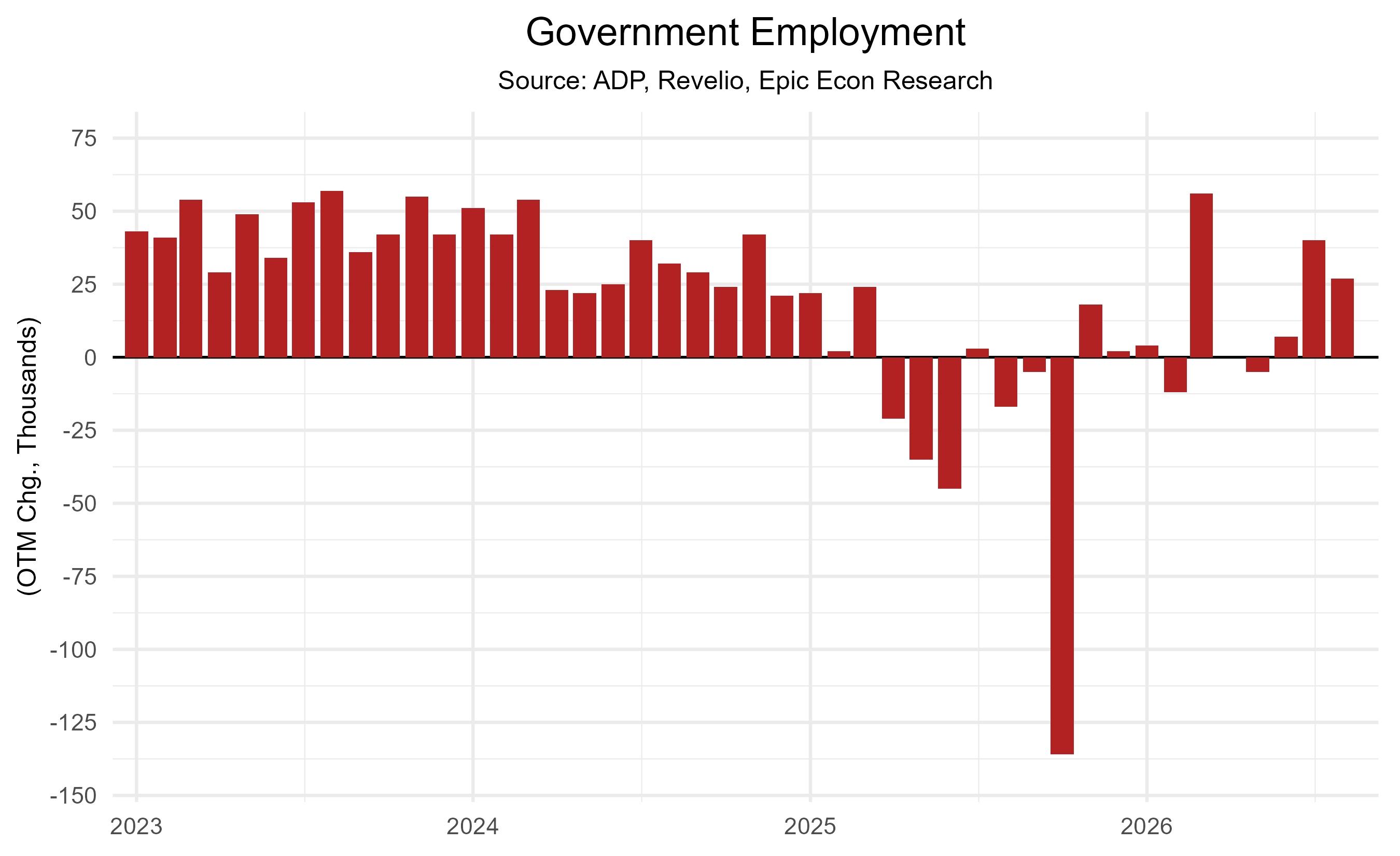
Government employment increased by an estimated 27,000 in August, but I would place relatively little weight on this number.
Government employment in this report is derived from Revelio career-profile data because ADP does not cover public-sector employment. Online career profiles have historically been slow to capture layoffs and departures from government positions.
That problem was obvious in July. The current private-sector dataset estimates government employment increased by roughly 40,000 that month, while the BLS establishment survey reported a 53,000 decline. By contrast, the private-sector component of this report estimated private payroll growth of 28,000 in July, almost exactly matching the official BLS increase of 30,000.
For that reason, I would place more faith in the 24,000 increase in private nonfarm employment as a measure of the underlying August labor market than the 52,000 total-nonfarm headline.
Government job postings also fell sharply in August (-24,000) and are now 16.0 percent below January 2025.
Employment changed little in other services (+2,000), natural resources and mining (-2,000), and the remaining industries.
Job Postings
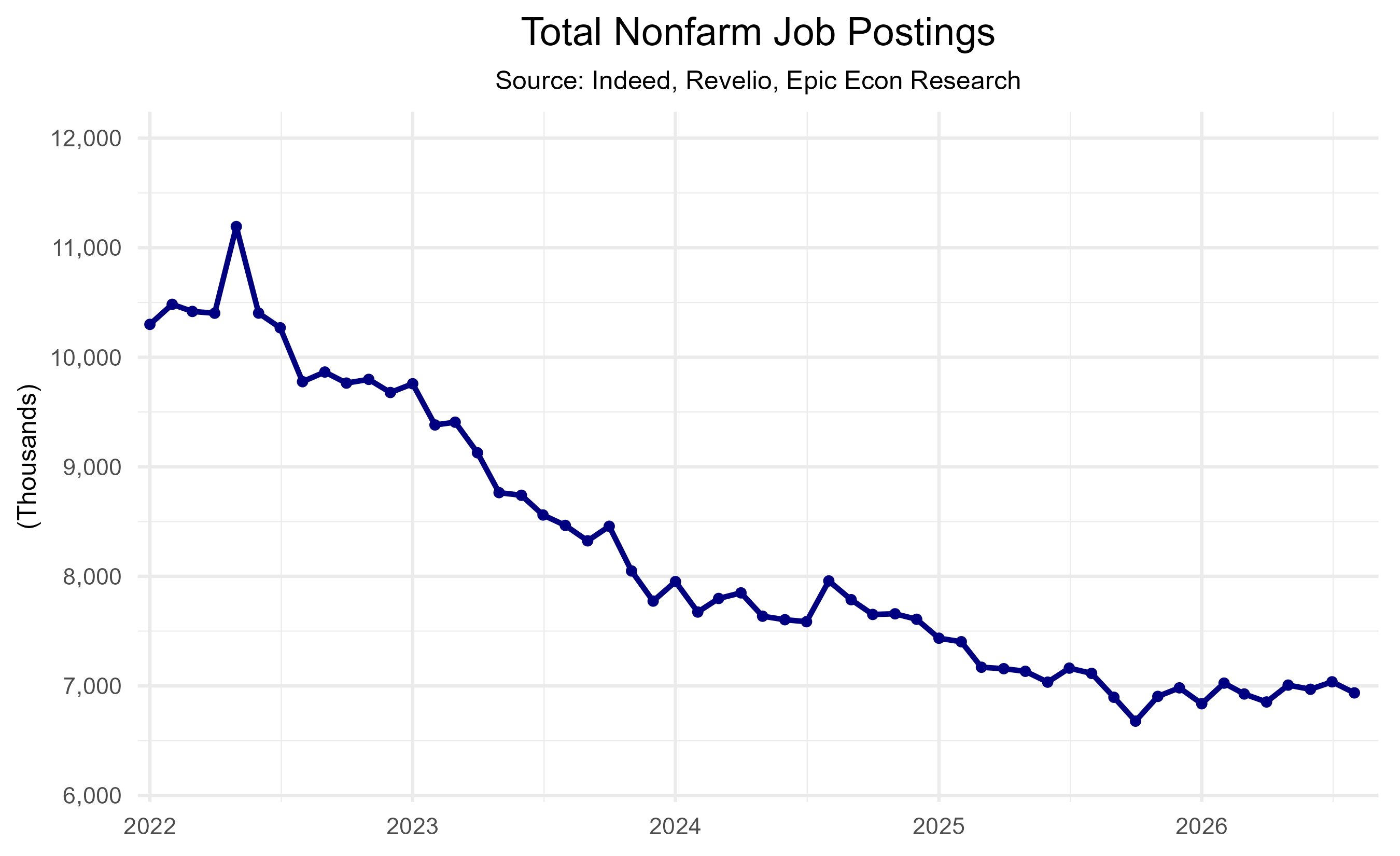
The number of currently active job postings declined by 101,000, or 1.4 percent, to 6.936 million in August.
There are now roughly 499,000 fewer job opportunities than in January 2025, a decline of 6.7 percent. Job postings are about 38 percent below their 2022 series high.
This is consistent with the broader official data. The latest JOLTS report showed 7.3 million job openings in July, but hiring fell to 5.1 million. Both hiring and total separations remain at relatively low rates, reinforcing the picture of a low-hire, low-fire labor market.
Goods-Producing Sectors
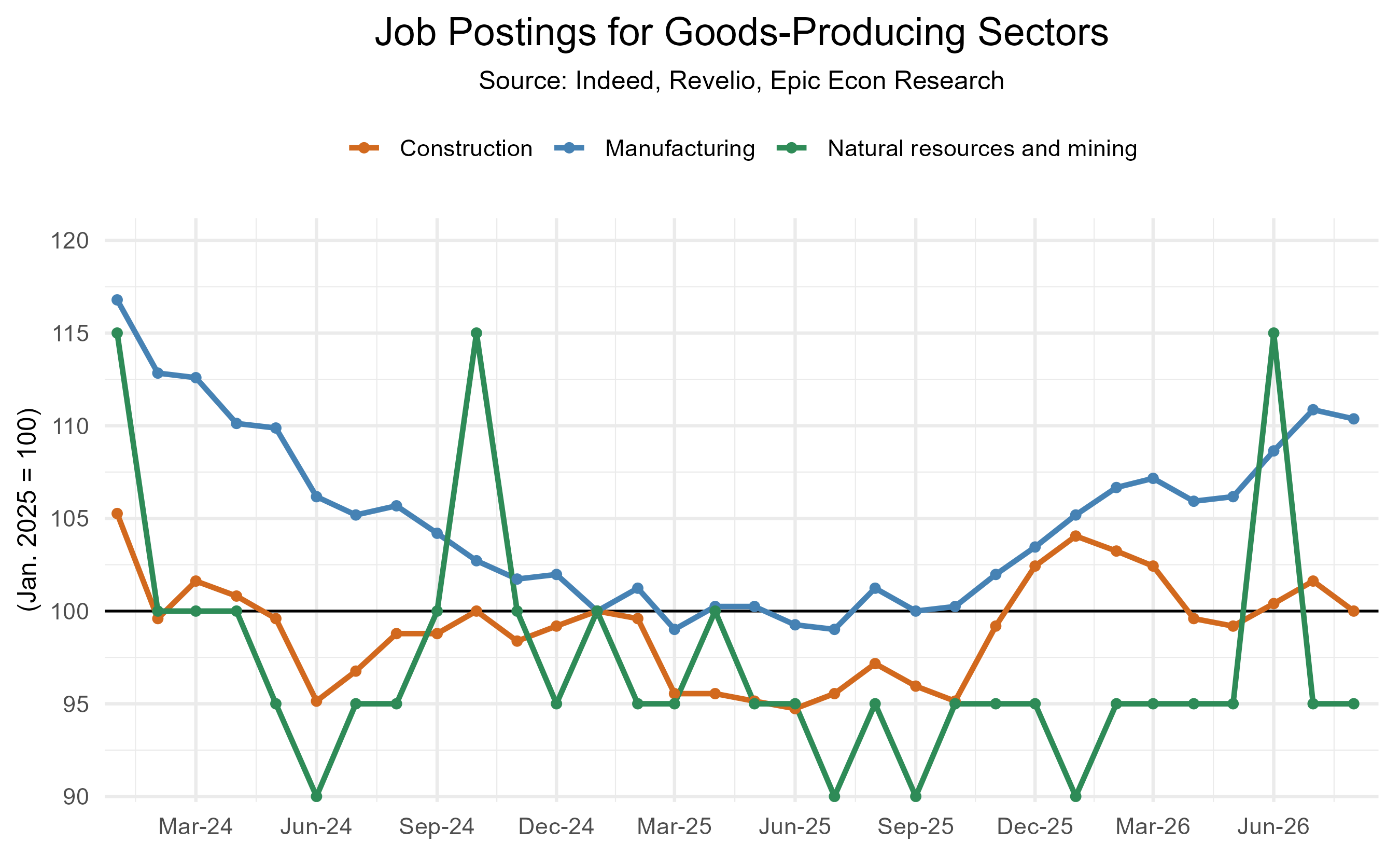
Job postings in goods-producing industries declined slightly in August but remain 6.1 percent above their January 2025 level.
The strength is almost entirely attributable to manufacturing, where postings are 10.4 percent above January 2025 despite falling employment.
Construction postings are essentially unchanged from January 2025, while natural resources and mining postings are approximately 5 percent lower.
Tradeable Services
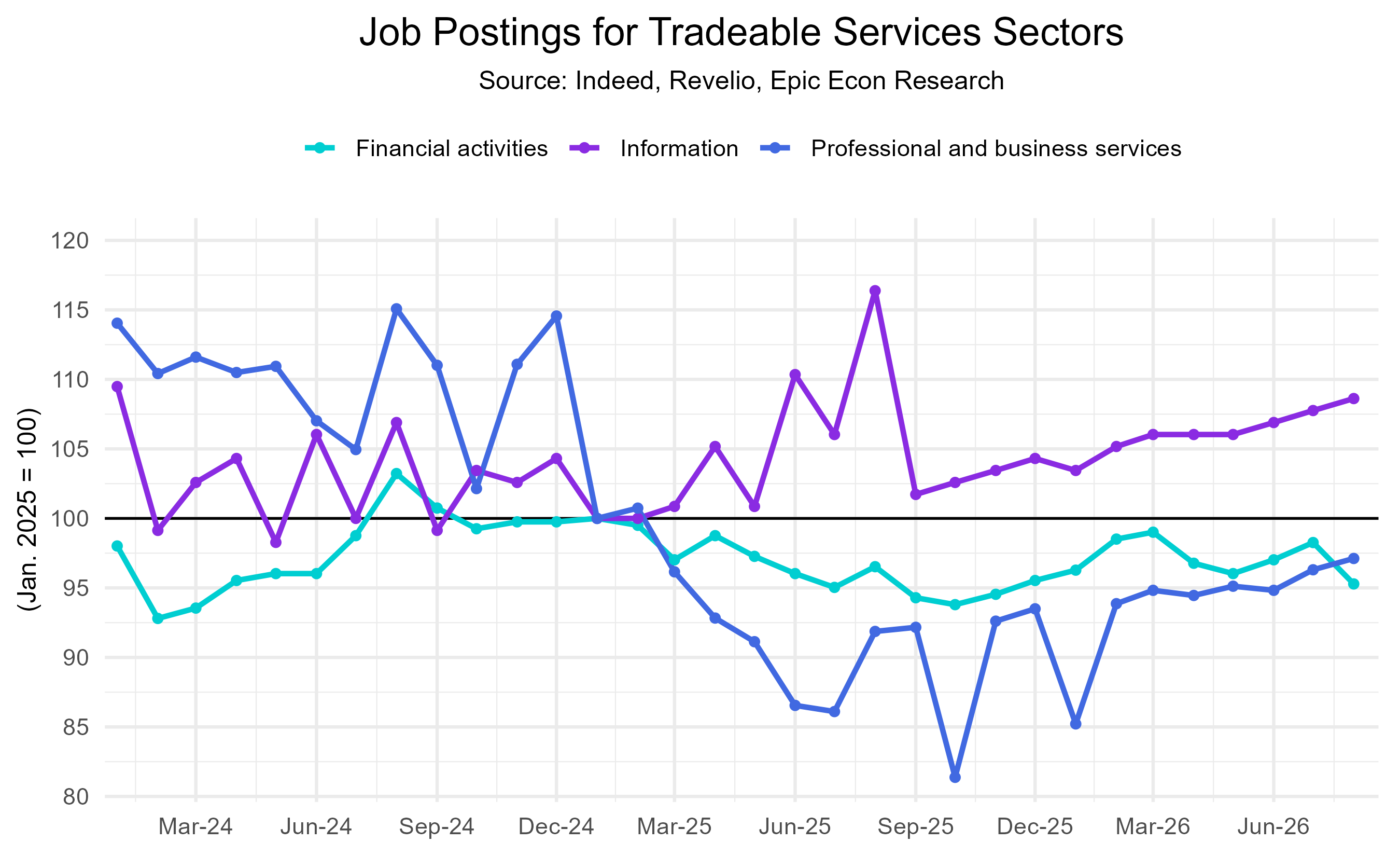
Job postings in tradeable services were essentially unchanged in August and remain just 2.6 percent below January 2025.
Professional and business services postings increased by 11,000, while information edged up by 1,000. Financial activities declined by 12,000.
Tradeable services have performed considerably better than non-tradeable services over the past year, another piece of evidence against the idea that white-collar e employment is experiencing a generalized collapse.
Non-Tradeable Services
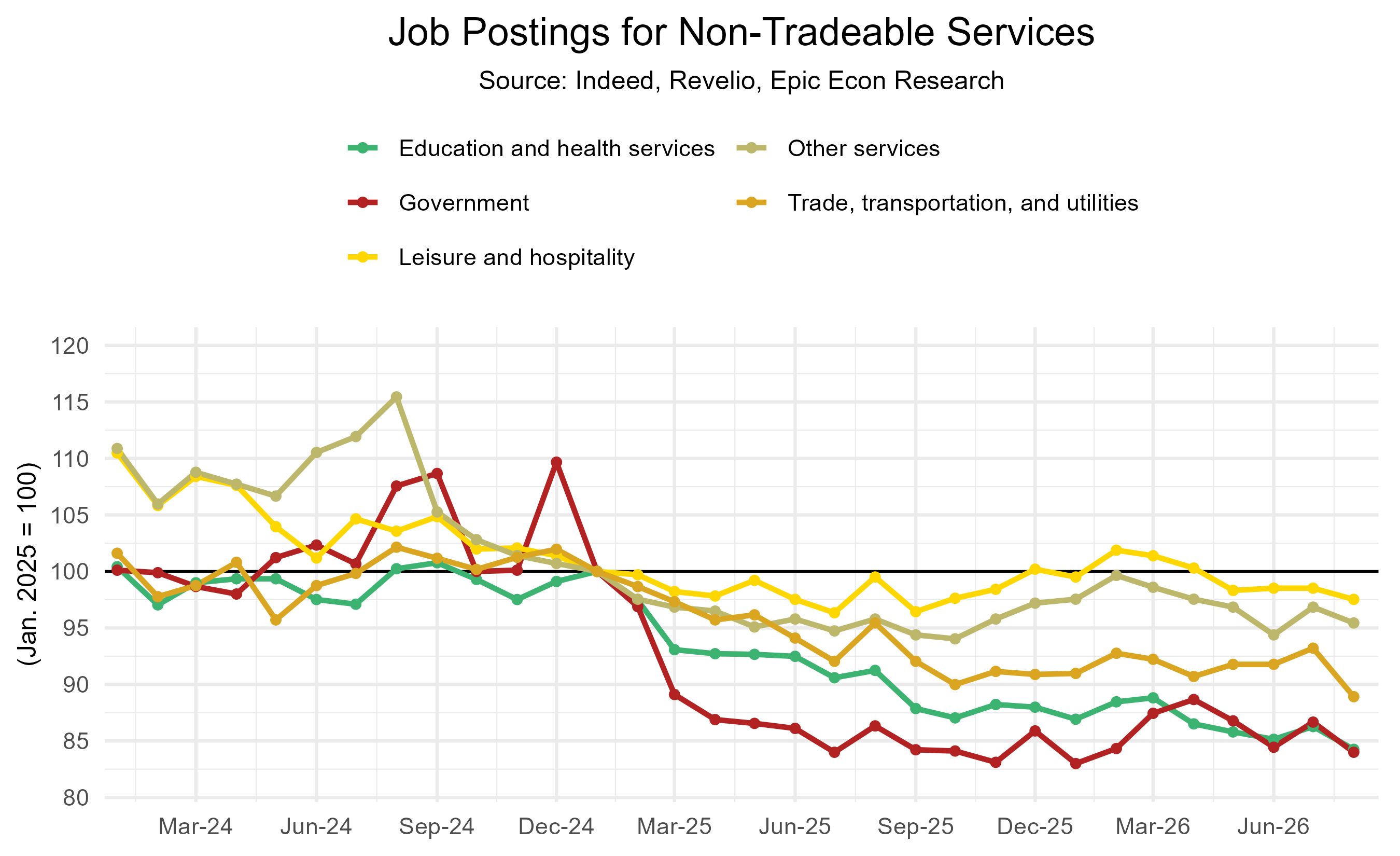
The decline in labor demand remains concentrated in non-tradeable services. Job postings in these industries declined by approximately 2.6 percent in August alone and are now 11.4 percent below January 2025.
The largest declines over the month occurred in trade, transportation, and utilities (-48,000), education and health services (-34,000), government (-24,000), and leisure and hospitality (-10,000). Since January 2025, postings are down 16.0 percent in government, 15.7 percent in education and health services, and 11.1 percent in trade, transportation, and utilities.
Conclusion
August’s private-sector labor market data are singing the same old song and dance: the U.S. labor market remains stagnant.
Private employers added an estimated 24,000 workers. Education and health services remains the strongest source of job creation, but even there employment growth is slowing and job postings continue to decline. Construction remains resilient, and there are some positive signs in manufacturing, but trade, transportation, and utilities, and leisure and hospitality remain weak.
But there is limited evidence of widespread layoffs. The 101,000 decline in job postings is probably the most concerning number. Businesses appear increasingly reluctant to create new positions, particularly in locally oriented service industries.
External conditions are not especially favorable. The continuing conflict with Iran and elevated energy prices are increasing costs for businesses and households, while tariffs and restrictive immigration policy remain additional headwinds for labor-intensive industries. These factors are occurring at the same time the Federal Reserve remains primarily worried about above-target inflation, limiting the potential for monetary policy to cushion a labor-market slowdown.
For tomorrow’s official Employment Situation, I would put substantially more weight on the 24,000 private-payroll increase than the 52,000 total-nonfarm estimate because of the shortcomings in the government employment data. My expectation is another mediocre month, with total payroll growth somewhere around 35,000 to 40,000 and the unemployment rate remaining near 4.1 percent.
The labor market is fine. But opportunities for workers continue to narrow, and there is little evidence that will change heading into fall.
Onward, forward.
-Evan